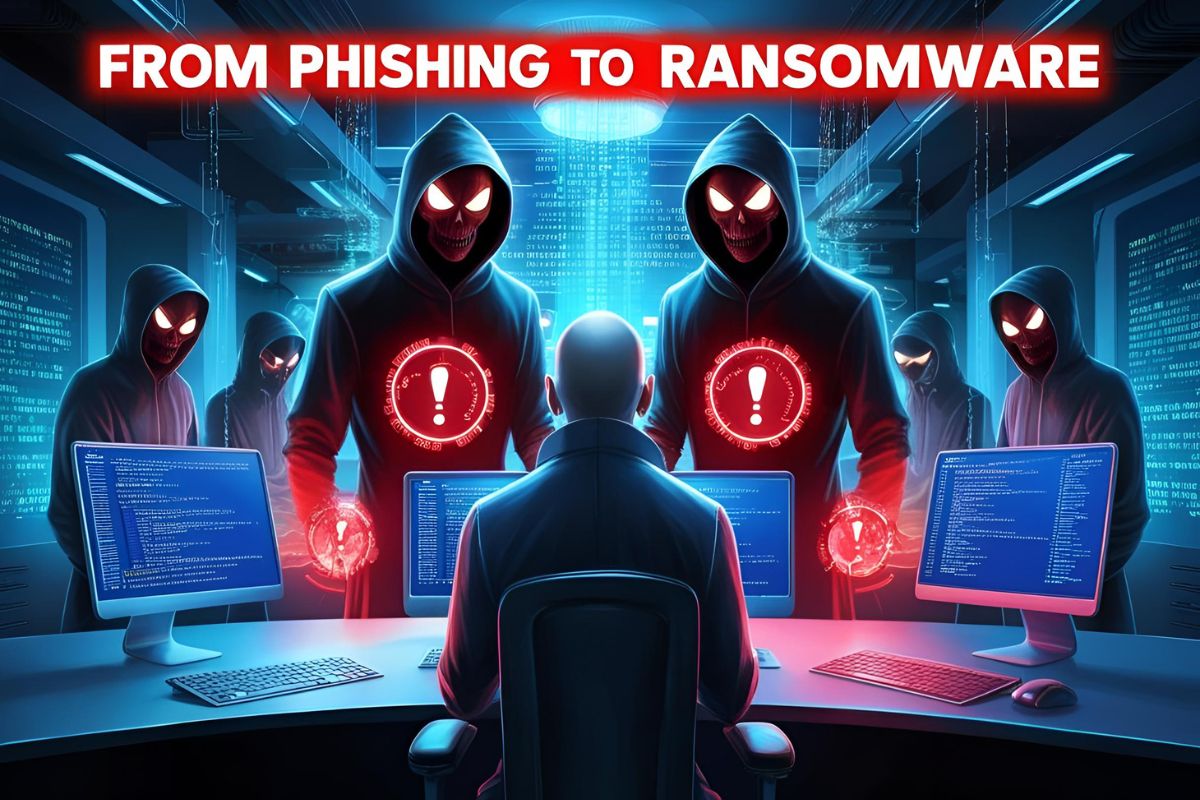
Over the last ten years, cyber threats have grown in scale, complexity, and impact. From deceptive phishing emails to sophisticated ransomware attacks that cripple critical infrastructure, the digital landscape has become a battleground where attackers innovate faster than ever before. This evolution reflects not only the growing capabilities of cybercriminals but also a significant shift in their motivations, targets, and tactics.
The Rise of Phishing: The Gateway Threat
Phishing has been a persistent threat since the early days of the internet, but the past decade has seen it evolve into a highly targeted and professionalized form of cybercrime.
Early 2010s: Spray and Pray
In the early 2010s, phishing attacks were largely generic. Mass emails claiming to be from banks, lottery commissions, or tech companies were sent in bulk, hoping to deceive unsuspecting users into sharing credentials or downloading malware.
Mid-to-Late 2010s: Spear Phishing and Business Email Compromise
As awareness grew, so did attacker sophistication. Spear phishing emerged as a more tailored approach, using social engineering to trick specific individuals or organizations. Business Email Compromise (BEC) schemes flourished, with attackers impersonating executives to authorize fraudulent wire transfers. According to the FBI, BEC attacks caused over $43 billion in global losses between 2016 and 2022.
Malware and Exploits: A Diversified Arsenal
While phishing served as the delivery vehicle, the payloads diversified. Trojans, spyware, keyloggers, and rootkits became common tools in cybercriminal toolkits.
Exploit Kits and Zero-Day Vulnerabilities
Exploit kits like Angler and Neutrino automated the process of delivering malware through compromised websites. Meanwhile, zero-day vulnerabilities—unknown flaws in software—were increasingly traded on the dark web, often used by state-sponsored groups.
Fileless Malware
By the late 2010s, attackers began leveraging fileless malware, which lives in memory and exploits legitimate system tools (like PowerShell), making detection significantly harder for traditional antivirus software.
The Ransomware Revolution
No threat has reshaped the cyber landscape more dramatically in the last decade than ransomware.
Early Ransomware: Scareware and Screen Lockers
Initially, ransomware acted more like scareware—locking users’ screens with fake legal threats demanding small payments. These early variants were relatively easy to remove or bypass.
The Encryption Era: CryptoLocker and Beyond
The 2013 appearance of CryptoLocker marked a turning point. It encrypted victims’ files and demanded payment in Bitcoin. Over the next few years, ransomware matured, with high-profile strains like WannaCry, Petya/NotPetya, and Ryuk wreaking havoc across hospitals, businesses, and government agencies.
2020s: Ransomware-as-a-Service (RaaS)
Today, ransomware has become commodified. Ransomware-as-a-Service (RaaS) platforms enable even low-skilled actors to launch devastating attacks. Groups like REvil, DarkSide, and LockBit operate like businesses, offering affiliates revenue shares, tech support, and even press releases. Double extortion—where attackers steal data before encrypting it and threaten to leak it—adds further pressure on victims.
Nation-State and Supply Chain Attacks
Beyond financially motivated attacks, geopolitical tensions have played out in cyberspace. State-sponsored actors have been linked to espionage, intellectual property theft, and infrastructure disruption.
SolarWinds and Colonial Pipeline
In 2020, the SolarWinds attack revealed the dangers of supply chain compromise, where trusted software was used as a backdoor into thousands of organizations, including U.S. federal agencies. In 2021, the Colonial Pipeline ransomware attack disrupted fuel supplies on the U.S. East Coast, highlighting how digital threats can have real-world consequences.
Cyber Espionage and Hybrid Warfare
Advanced Persistent Threats (APTs) such as APT29 (Cozy Bear) and APT28 (Fancy Bear), often attributed to Russian intelligence, have targeted elections, vaccine research, and government agencies. Cyber operations now play a crucial role in hybrid warfare strategies, blurring the lines between criminal activity and state aggression.
The Human Factor and Social Engineering
Despite advances in security technology, humans remain the weakest link. Cyber attackers have refined social engineering techniques, exploiting emotions, urgency, and trust to manipulate users.
- Deepfake voice scams have emerged, impersonating executives to authorize wire transfers.
- AI-generated phishing messages have become more convincing and grammatically accurate.
- Even security professionals can fall prey to multi-layered impersonation schemes.
The Role of Artificial Intelligence and Automation
As attackers have embraced automation and machine learning, defenders have followed suit. AI now plays a crucial role in:
- Threat detection and response through behavior analytics
- Email filtering that identifies malicious patterns
- User behavior analytics (UBA) to detect anomalies
However, AI is a double-edged sword. The same technologies are being weaponized by attackers to craft more evasive malware, automate reconnaissance, and simulate legitimate behavior.
Defending in a New Era
The past decade has taught us that traditional defenses are no longer enough. Cybersecurity strategies have evolved to include:
- Zero Trust Architecture: Trust nothing, verify everything.
- Multi-Factor Authentication (MFA): Now a standard defense layer.
- Endpoint Detection and Response (EDR) and XDR: Advanced tools for identifying and isolating threats quickly.
- Cybersecurity training and awareness: Still one of the most impactful defenses.
Looking Ahead
As we move into a new era, the evolution of cyber threats shows no signs of slowing down. Quantum computing, AI-generated malware, and increasingly interconnected IoT devices may introduce threats we can barely imagine today.
Organizations must stay vigilant, invest in adaptive security frameworks, and treat cybersecurity not as an IT issue—but a core business priority. The last decade was a wake-up call. The next decade will be a test of resilience.